Using Entity Manipulation Language (EML) to Access RAP Business Objects
If we consider a RAP BO with a root entity named Entity1 and a child entity Entity2, then the response types have two components named Entity1 and Entity2. Only the derived type for reported has an additional component named %others, which is also an internal table but with an elementary line type.
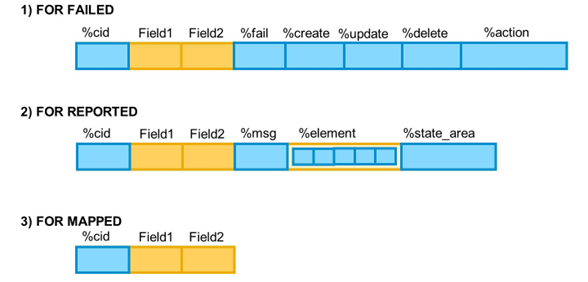
Components of Response Operands
The line types of the table-like components are also derived types, namely the derived types STRUCTURE FOR FAILED , STRUCTURE FOR REPORTED , and STRUCTURE FOR MAPPED .
These types contain the key fields of the related entity plus some generic fields for the details. As usual, the additional fields start with % to avoid naming conflicts.
We will discuss some of these additional fields later in this course.
Short Form and Long Form
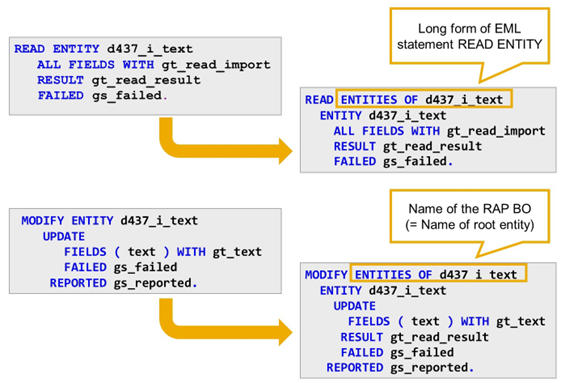
Short Form verus Long Form
Statements READ ENTITY and MODIFY ENITITY are short forms of their longer versions READ ENTITIES OF and MODIFY ENTITIES OF.
In the long version, the keyword OF is followed by the name of a RAP BO, which is identical to the name of its root entity. The affected entity is specified after keyword ENTITY. The rest of the statement is the same in long form and in short form.
The long form allows you to bundle several operations in on statement, either different operations on the same entity (for example, delete some instances and update some other), or operations on different entities of the same RAP BO (for example, create a root entity instance and related instances of a child entity in one call).
The short form is most suitable for RAP BOs, which consist of only one entity (the root entity).
Alias Names for Entities
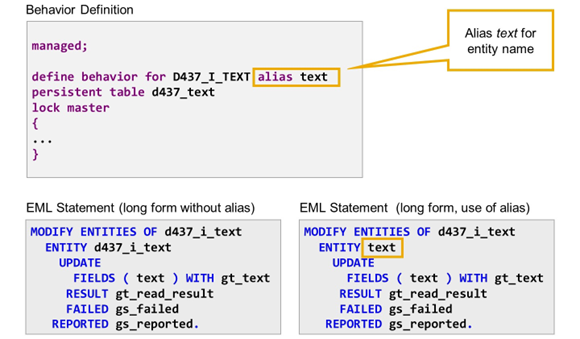
Aliases for RAP BO Entities
In behavior definition, the name of an entity is derived from the name of the related CDS view. In addition, you can provide an alias name for the entity. In the example, alias text is assigned to entity D437_I_TEXT.
In some positions, the technical name of an entity can be replaced with the alias name. This can help increasing readability and re-usability of code. In the example, the alias text is used in the long form of an EML statement to identify the entity.